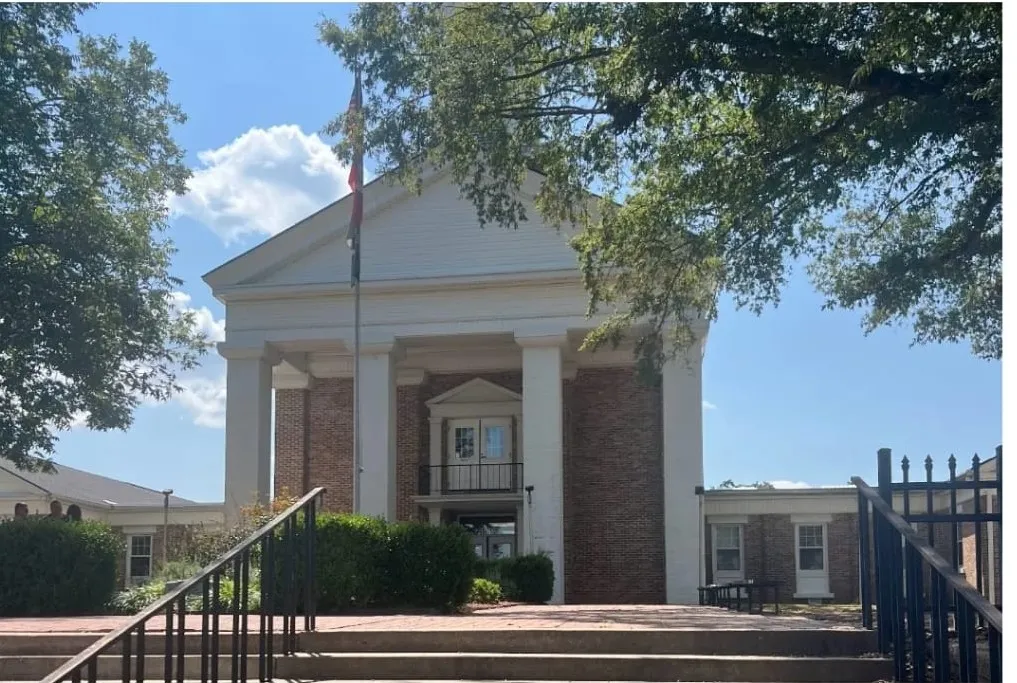
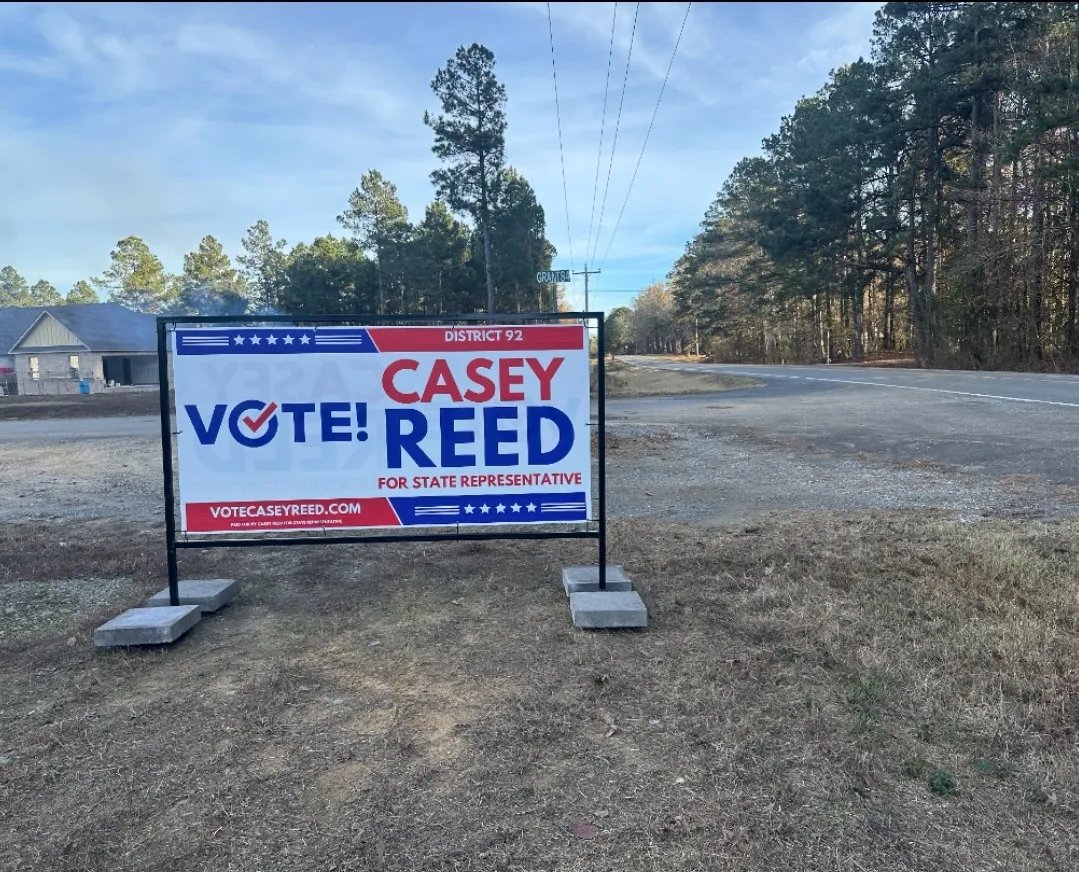
Casey Reed filed to run for House District 92 in October because he wanted to make a difference in Grant County.
With long-time Republican state Rep. Julie Mayberry opting not to run for re-election, Reed, a Realtor whose family homesteaded in Grant County generations ago, saw a chance to throw his hat in the ring.
He was already involved in his community serving on the legislative committee for the Arkansas Realtors Association, president of the Sheridan, Lost Creek Cemetery Association and board member of Little Creek Water Association. Why not run for office?
The fact that two other Republican candidates – Eric Shepherd, a Realtor and firefighter, and Dawn Creekmore, a mortgage lender for People's Bank who once served as a Democratic legislator – were in the race did not phase Reed. Shepherd had already secured big name endorsements from local Republicans and state office holders.
Reed, a segreant and combat engineer in the U.S. Army Reserve, remained unphased.
Suddenly Casey Reed signs were throughout Grant and Saline Counties – at major intersections in Sheridan and rural areas like Grapevine, Leola, Poyen and Prattsville.
Reed was on a roll, an unlikely candidate who didn't bow down to party leaders or the county's power players.
"I ran for office because I saw our community facing challenges and a need that wasn’t being represented," Reed told the Reckoning. "It was time to make a change, and I felt led to step in. I believe this position should serve the people, not the other way around. We fight for what we have here, for our people, for our values, and for our community."
Then bang! Life changed suddenly for Reed.
A past he thought was just that – the past – came roaring back to haunt him.
Why? For one simple reason: Reed decided to run for office in a tense political year, especially in Grant County a place deeply divided because of the possible construction of a data center.
The Republican Party of Arkansas took Reed's $3,000 filing fee on Oct. 4. By mid-November the opposition research on Reed was in full swing.
What happened in 2012?
Reed's situation in 2012 was complicated and curious. It is still as complicated and curious in 2026.
According to Reed, his attorney at the time was Larry Allen who also served as district judge in Grant County.
Reed told the Reckoning he dropped off a $500 check to Allen for legal work for a man he had only met once and left a note on Allen's desk.
Reed, who was then 29 years old, was arrested in October 2012 following a one-month state police investigation, according to a 2012 article from the Sheridan Headlight written by David Jeffrey.
The Reckoning sent a Freedom of Information request to the Arkansas State Police requesting the investigation. The Arkansas State Police could not find any investigation into Reed.
Nonetheless, according to the Headlight, Reed was arrested because Allen turned over the note and money to Eddy Easley who was in the waning days of his tenure as prosecuting attorney. In May 2012, Easley was elected as circuit judge and took that office in January 2013.
Reed told the Reckoning he was never handcuffed and simply went to the Grant County Sheriff's Office to hear the charge.
According to Reed, he originally hired Stephen Shirron as his attorney. Shirron is now a circuit judge and running for re-election. However, Shirron stopped representing Reed when he was appointed as prosecuting attorney in December 2012 by then-Gov. Mike Beebe.
Reed then hired T. Clay Janske of Hot Springs to represent him.
According to the 2012 Headlight article, Janske in December "immediately filed pre-trial motions asking for Reed’s trial to be moved out of Grant County citing negative publicity. He also asked for a special prosecutor to be appointed, citing that Judge Allen and Prosecutor Eddy Easley had a working relationship that created 'an appearance of conflict' and that Easley was a subpoenaed witness."
Circuit Judge Chris E. Williams was assigned the case. Williams resigned as judge in March 2024 amid investigations into cases he heard. Williams is "no longer eligible to be elected, appointed, or otherwise serve in the judiciary of the state of Arkansas," according to the Judicial Discipline & Disability Commission. Williams agreed to the terms.
According to the 2012 Headlight article, Williams denied Janske's request to move the trial to another venue because of negative publicity or delay the case. Williams also refused to appoint a special prosecutor although Janske argued that Allen and Easley had a "working relationship" creating "an appearance of conflict." Williams refused to allow Easley to be subpoenaed in the case.
The Reckoning examined the 2012 Headlight article because the case is now sealed – supposedly. Media outlets have recently reported that Reed was convicted of a "public trust" crime when no evidence points to a conviction.
Reed maintained his innocence, the Headlight reported in 2012. The article also noted Reed's case was rushed compared to other felonies at the time.
To this day, Reed maintains his innocence and insists the $500 was for Allen's services as an attorney and not a bribe because Allen was also a judge.
"No conviction has ever been made, and there is no criminal history listed for Casey Reed in ACIC or ASP records," Reed told the Reckoning. "A background check on Reed returns no results. In short, there is no criminal record —no convictions and no felonies."
Additionally, if any charges had resulted in a conviction, that information would appear in the same records relied upon by employers and the US military. No such information exists.
Reed said he has never had to have any rights – such as carrying a firearm restored – because none were ever taken away.
On Dec. 26, 2012, while most people celebrated the Christmas holidays in a historic snowstorm, Reed said he and Janske went to the Hot Spring County Courthouse instead of the Grant County Courthouse. Reed, who wanted a jury trial, said he has always thought that courthouse in Malvern was a strange choice considering Williams refused to move the venue when Janske asked.
Reed said the only people in the courtroom were Williams, Easley, Janske and himself. Reed said a court reporter was not present. Reed told the Reckoning that Williams told him if he didn't plea he would go to jail. Reed said Willians also told him if a jury found him innocent, he would set aside the verdict.
Reed pled nolo contendere – a plea accepting charges without admitting guilt, according to the 2012 Headlight article.
That same article stated Reed pled to "one count of attempted bribery of a public official."
The reporter wrote, "Because of this plea, Reed qualified as a first offender under the terms of Act 346. This law allows probation and to have a record sealed or expunged. Such a plea is not a conviction."
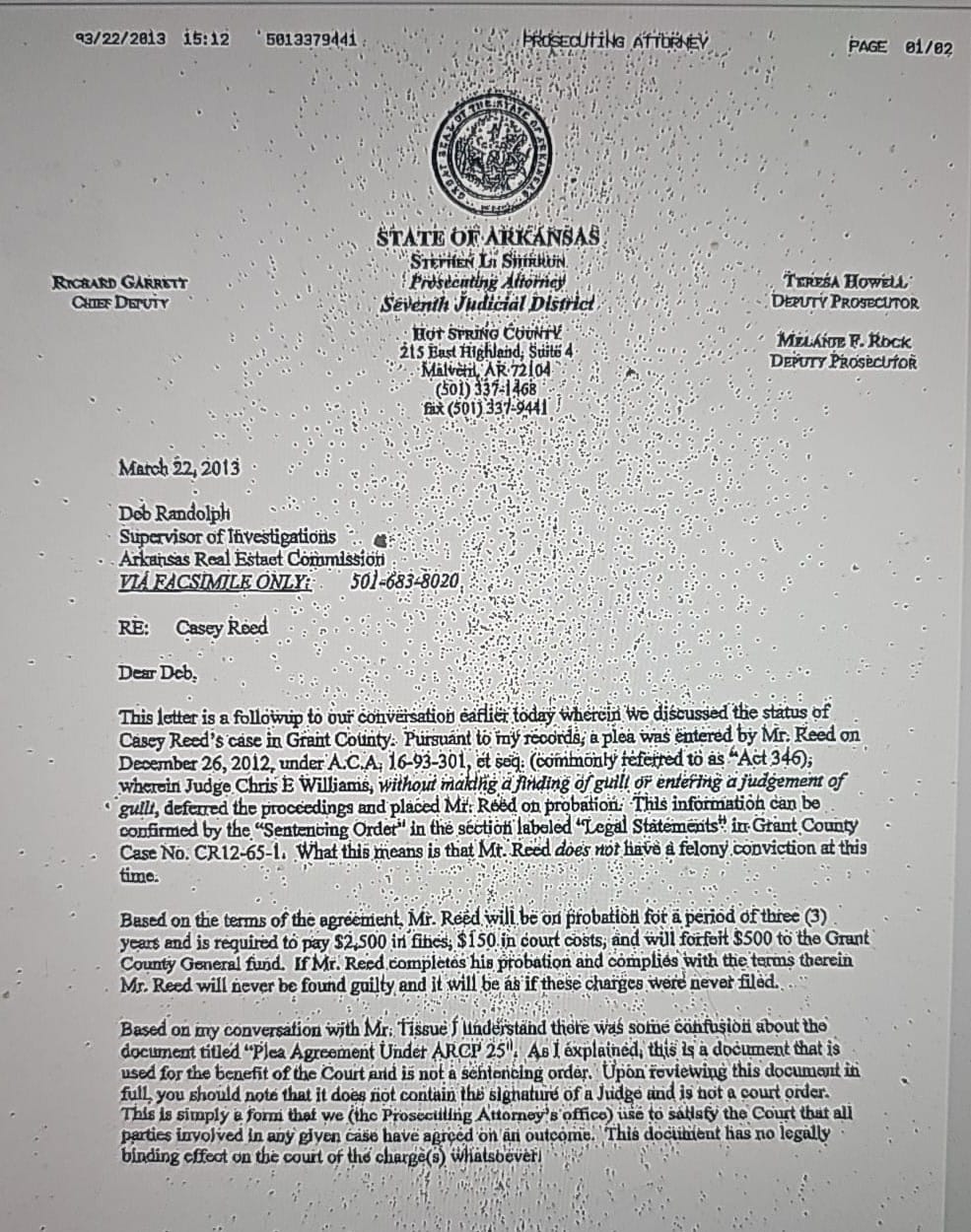
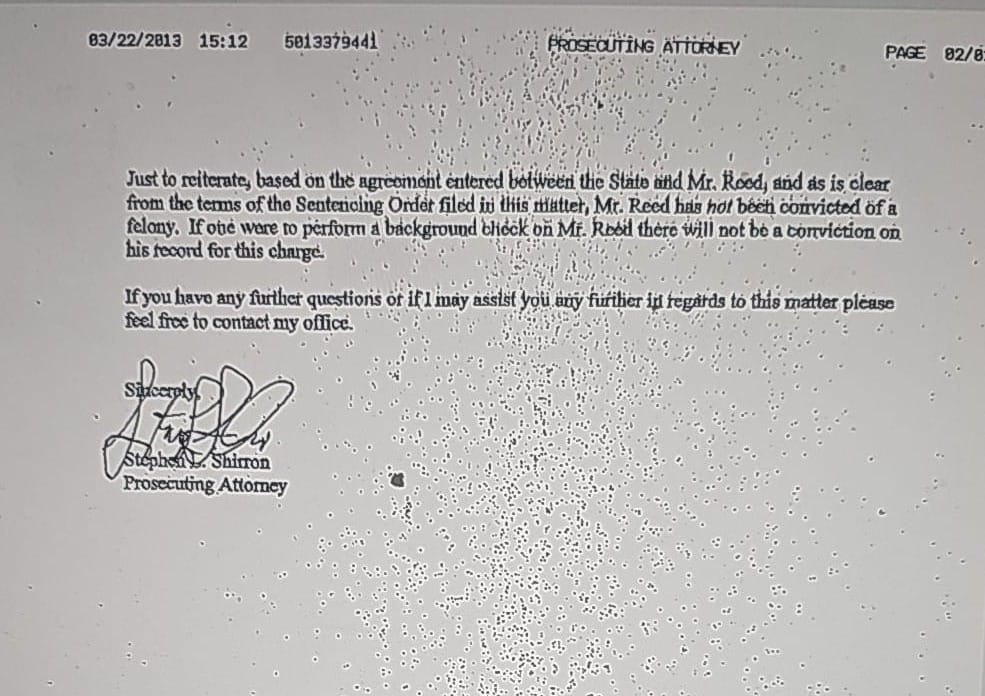
In March 2013 Shirron, as prosecuting attorney, wrote a letter on behalf of Reed and faxed it to the Real Estate Commission.
The Reckoning obtained the Shirron letter through a Freedom on Information request to the Real Estate Commission.
Reed filed a complaint with the Judicial Discipline and Disability Commission against Allen in April 2013. He provided the Reckoning with a copy of the Commission's response.
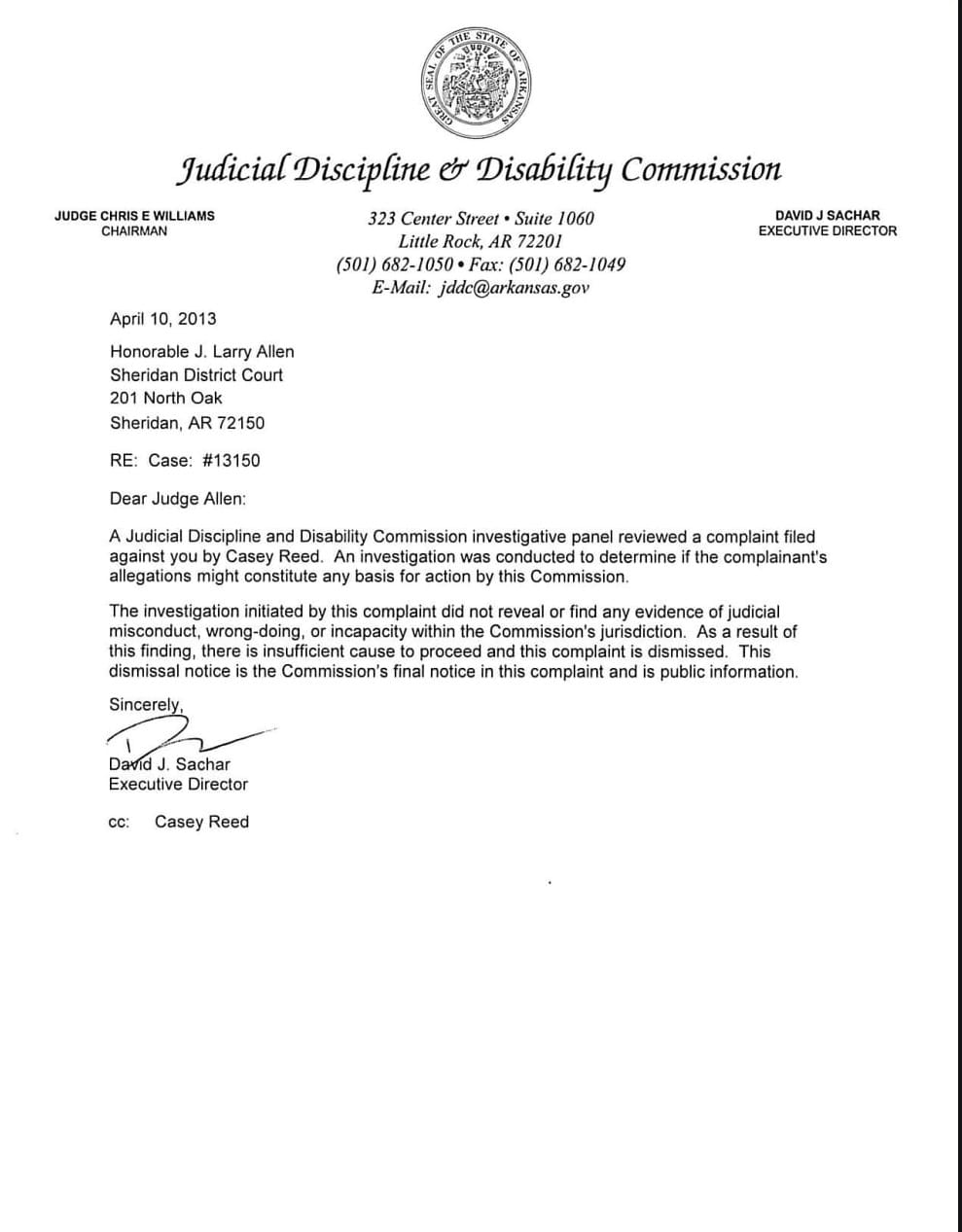
Who was the chairman of the JDDC at that time? Circuit Judge Chris E. Williams, the same judge that heard Reed's case on that snowy day in December and who resigned from the bench in 2024.
In the hundreds of pages concerning Reed from the Real Estate Commission three stand out.
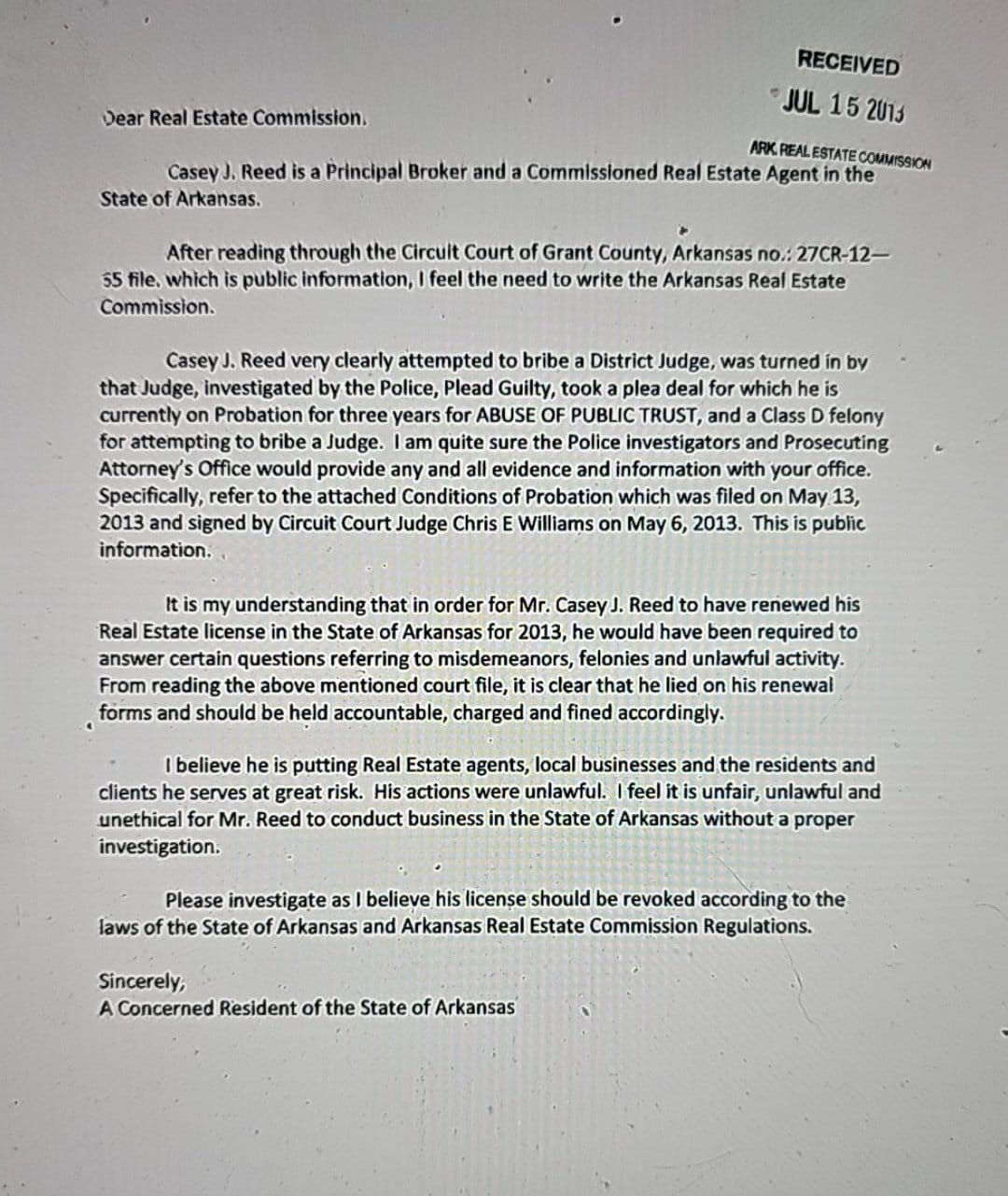
An anonymous letter was sent in July 2013 asking the Commission to investigate Reed.
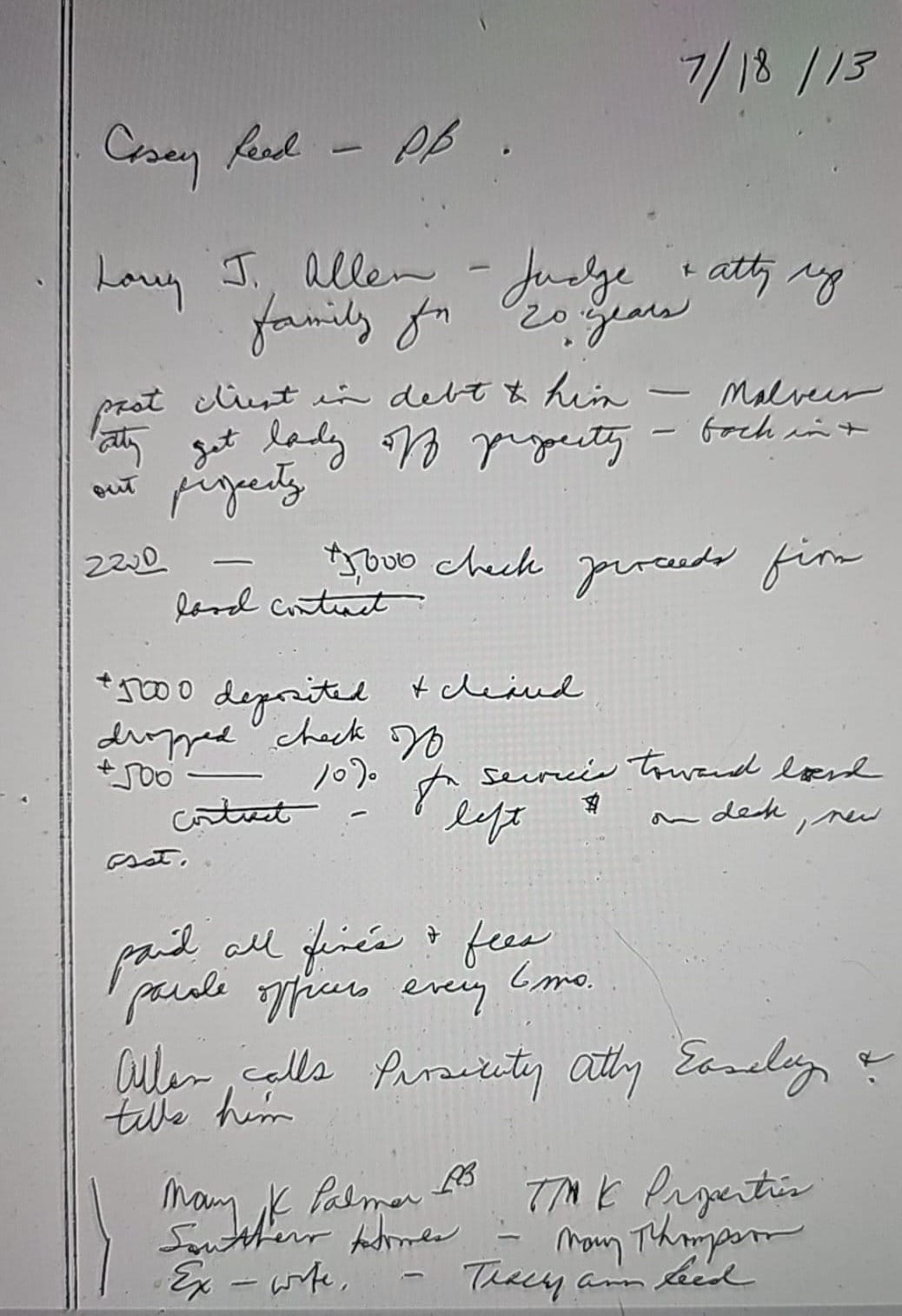
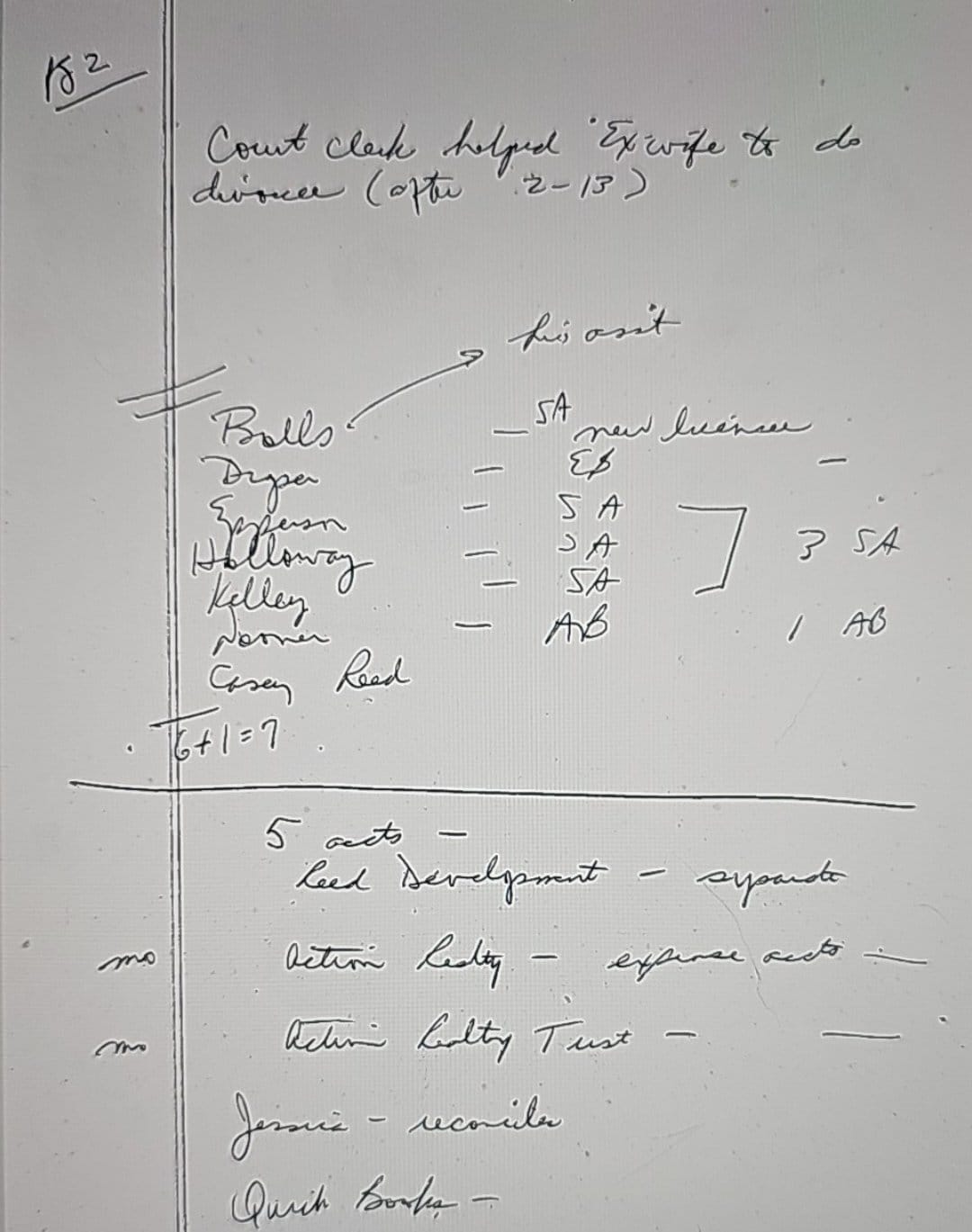
Two pages of cryptic handwritten notes were in the investigation file dated just days after the Commission received the anonymous letter.
Other documents in the file include the court filings in Williams court.
Janske corresponded heavily with the Real Estate Commission on behalf of Reed.
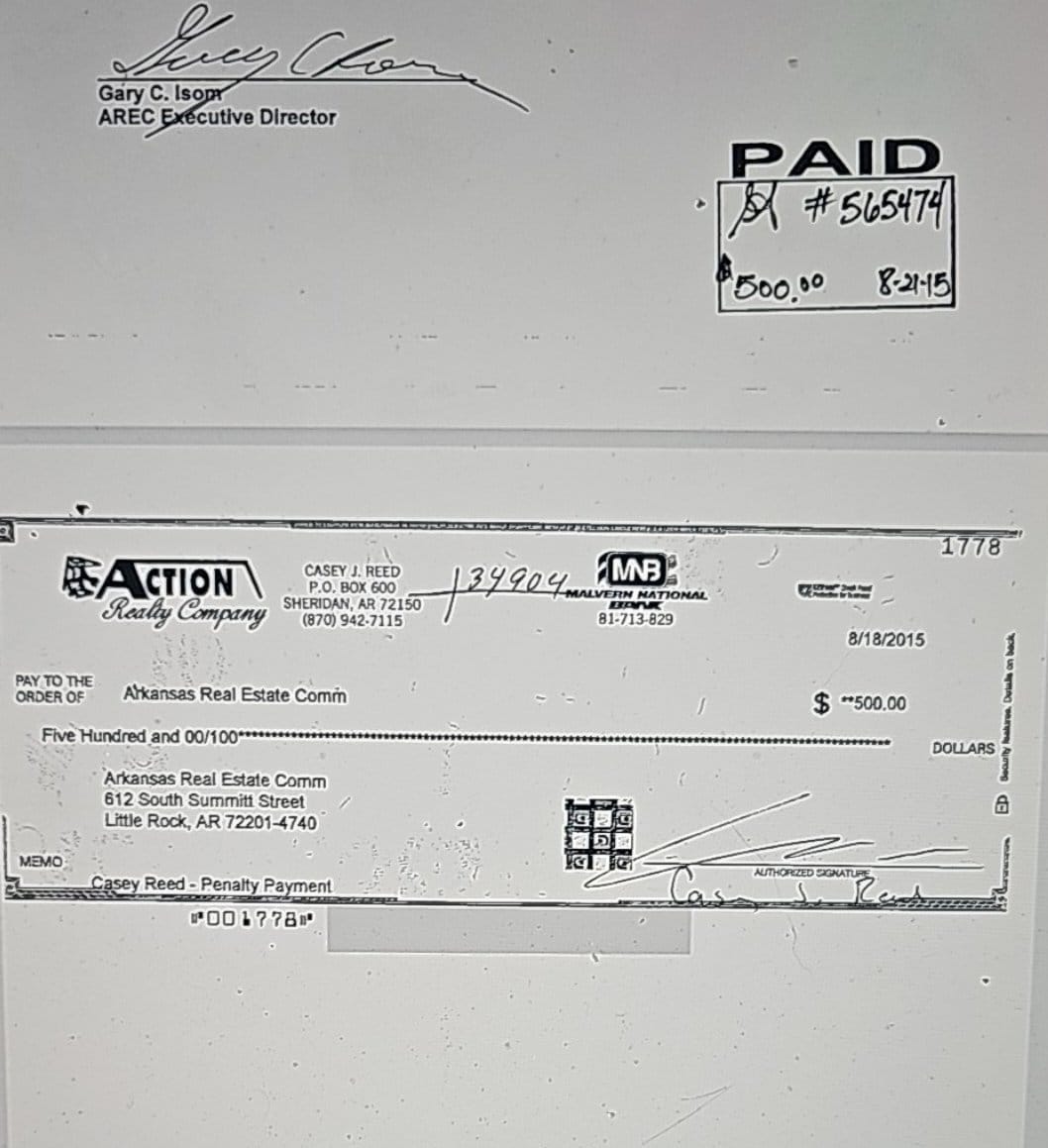
Ultimately, Reed paid a $500 penalty in August of 2015 to the Commission.
Ken Yang's 2025 lawsuit
On Dec. 22, 2025, Ken Yang, a Saline County Republican political consultant, sued Reed through his attorney Brett Watson of Searcy.
Yang also sued the Grant County Board of Election Commissioners; Saline County Board of Election Commissioners; Geral Harrison in his capacity as Grant County and Circuit Clerk; Doug Curtis in his capacity as Saline County Clerk; Joseph Wood, in his capacity as Chairman of the Republican Party of Arkansas and Cole Jester, in his capacity as Secretary of State.
Yang's lawsuit alleges that Reed cannot run for the House of Representatives because he pled guilty to abuse of public trust, a Class D felony. The lawsuit states: "Persons who have pled guilty to a public-trust crime are ineligible to file for, run for, or hold a seat in the Arkansas General Assembly. The Court should therefore forbid the Defendants from including Reed on any ballots or, if he is on the ballot, from counting or certifying any votes for Reed."
Documents from the Real Estate Commission were attached to Yang's lawsuit.
According to the Reckoning's FOIA to the Commission, two people sent FOIAs asking for Reed's file – a reporter for the statewide newspaper on Dec. 3, 2025, and Watson, Yang's attorney, on Dec. 19, 2025, just three days before the lawsuit against Reed was filed.
Watson was appointed to the Judicial Discipline and Disability last June by Attorney General Tim Griffin, who has endorsed Reed's opponent, Eric Shepherd.
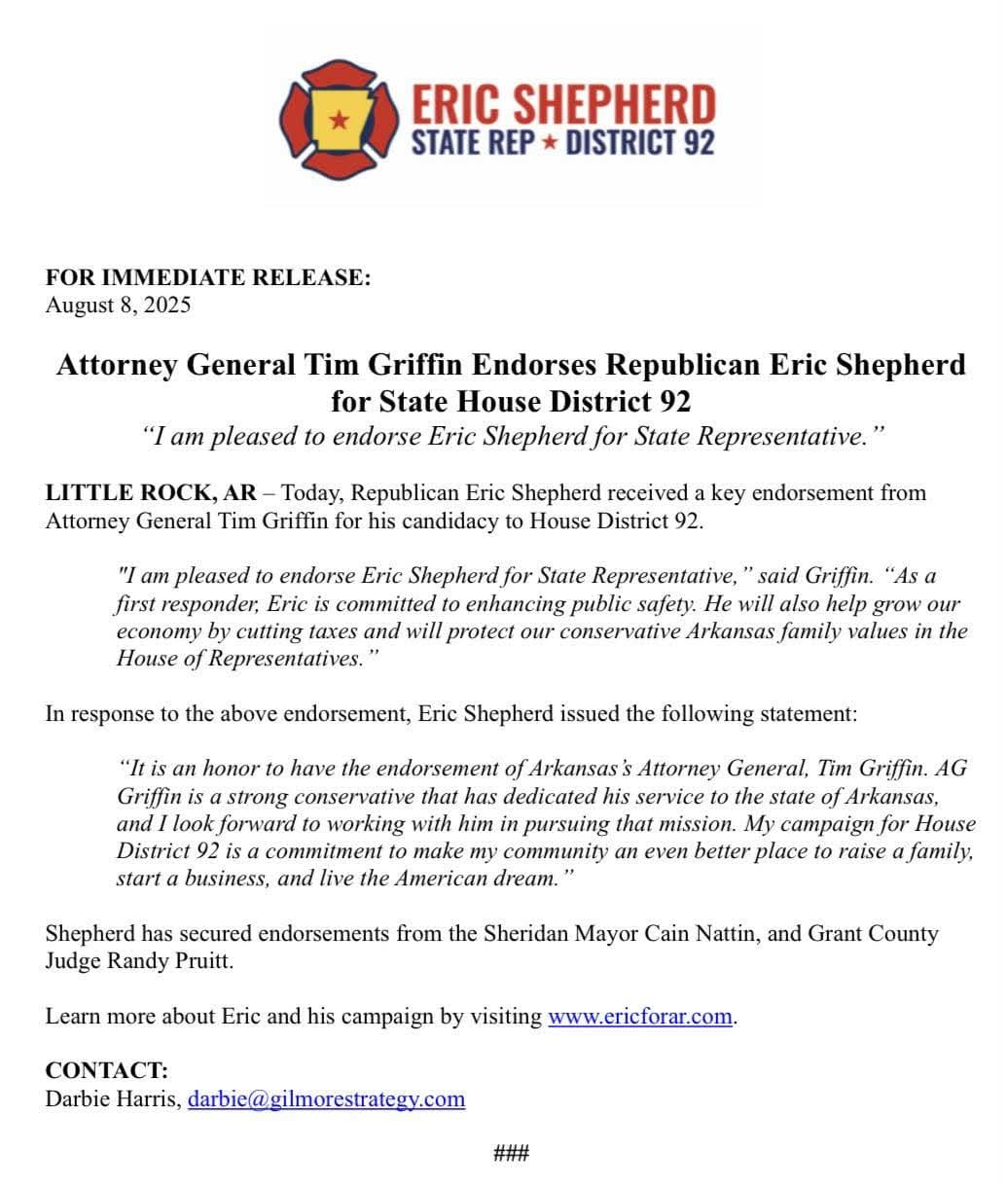
Griffin's re-election campaign also pays Watson for legal services, according to campaign filings at the Arkansas Secretary of State's office.
Pulaski County Circuit Court Judge Catherine Compton heard Yang's case on Jan. 8 in a hearing that lasted more than three hours.
Compton ruled that Reed committed a public trust crime but questioned the Arkansas law that addresses running for office if such a crime was committed.
She said, "I think that statute is overbroad, don't like it, but I'm not the one who gets to decide what the legislature determines, and that is what the legislature has determined."
Initially, Compton said Reed's name could not remain on the ballot.
Reed's Little Rock attorney Steve Harrelson, a former Democratic legislator and member of the Pulaski County Election Commission, argued that Reed's name should remain on the ballot because what would happen if her ruling was overturned.
Compton then allowed his name to remain on the ballot.
Harrelson said he planned to appeal the ruling to the Arkansas Supreme Court immediately.
Sealing and Unsealing of Documents
After Compton's ruling and while waiting for the appeal, Reed started investigating who had records about his life.
Reed said he thought the case was sealed everywhere, and he had no reason to believe otherwise.
He testified in court he called the governor's office to get his record expunged in 2020 or 2021. Someone in the Governor's office told Reed they could not find any documentation about the case.
Was anyone including the Reckoning even supposed to obtain documents about Reed?
Documents show that as early as 2017 Reed started trying to seal his record with the Real Estate Commission.
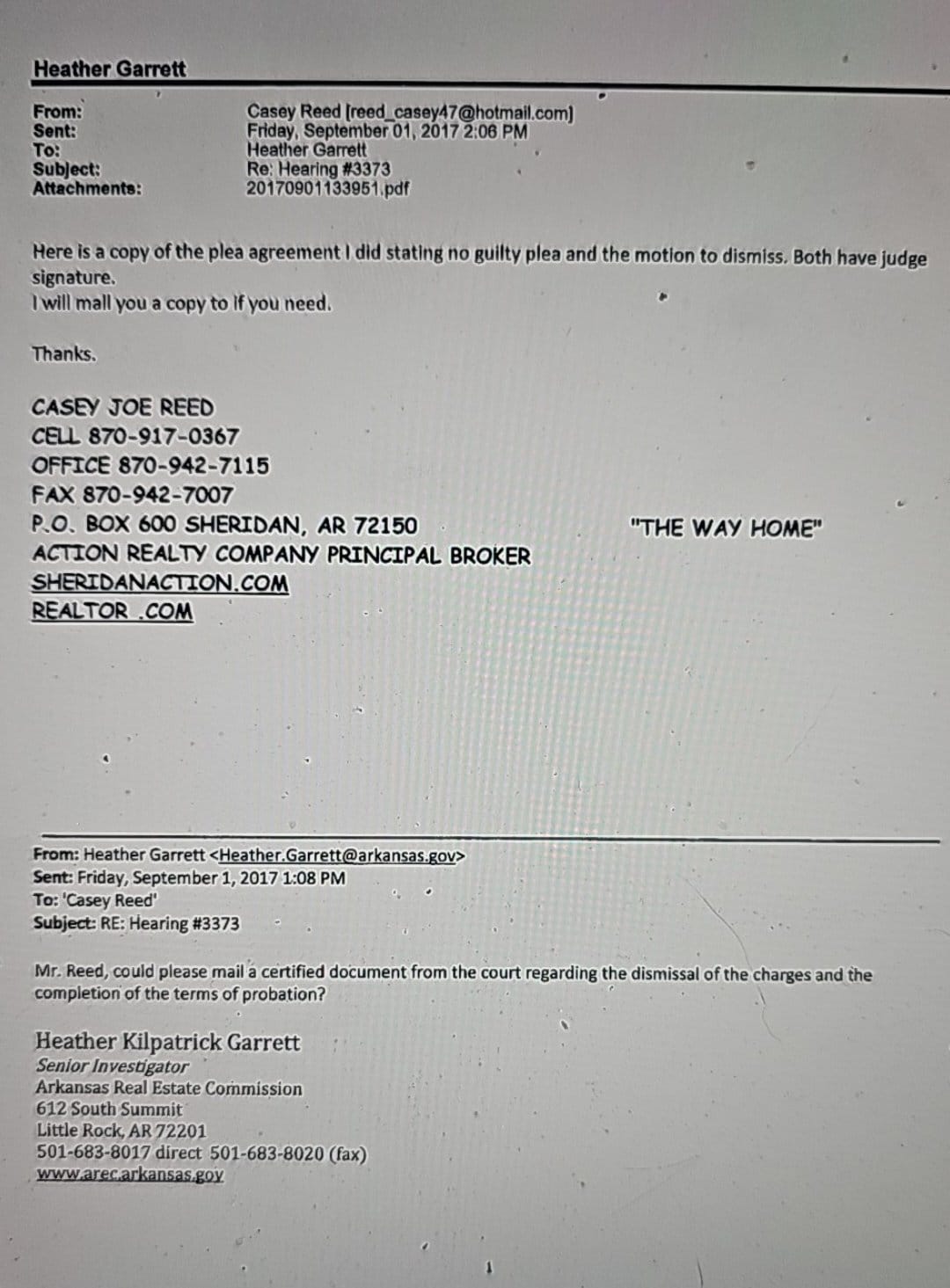
In 2021, Reed again sent an email to the Commission asking for his record to be sealed.
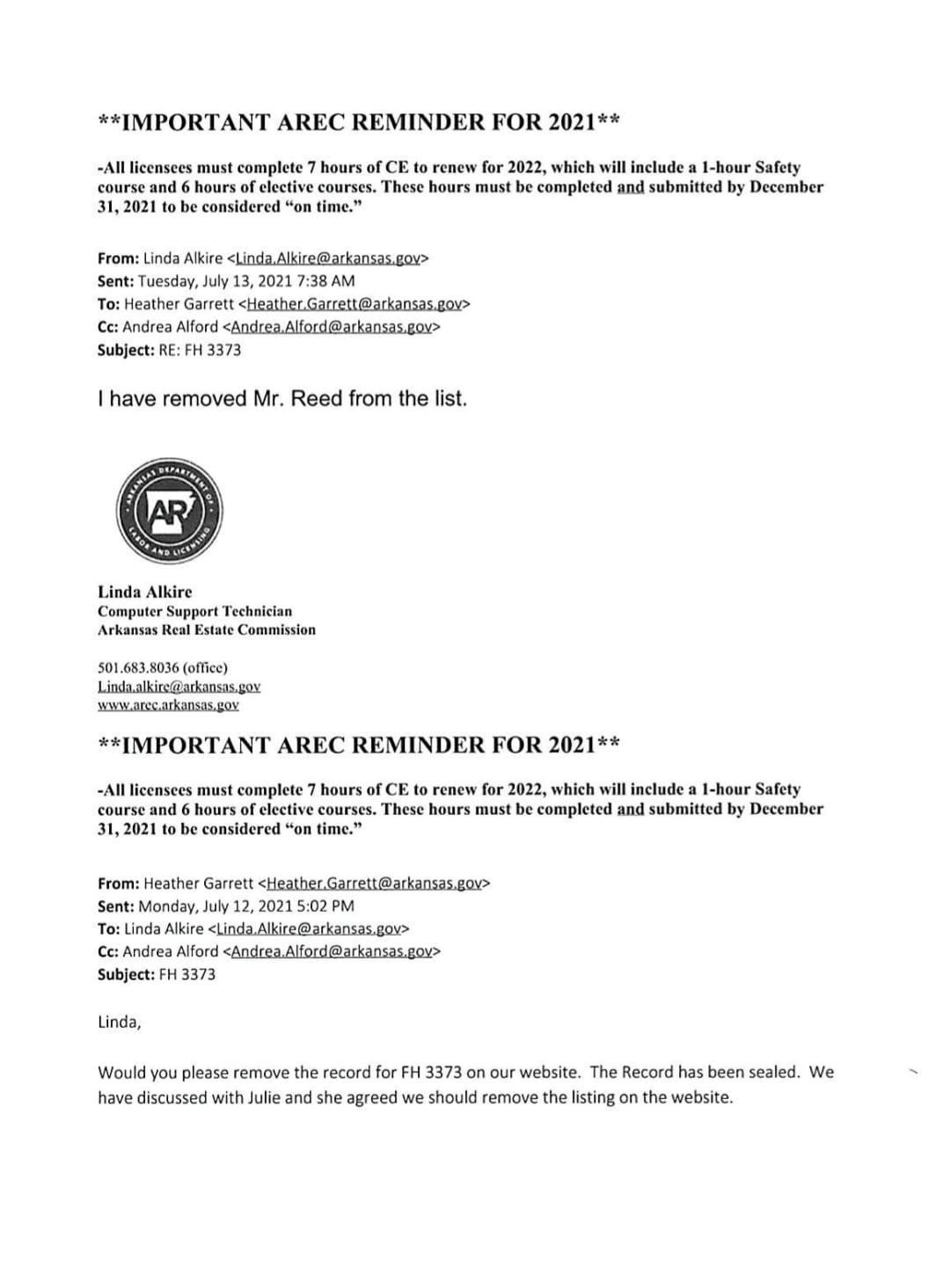
Heather Kilpatrick Garrett wrote to Linda Alkire, computer support technician for the Real Estate Commission asking for that be done.
Heather Henries was subpoenaed by Watson, Yang's attorney.
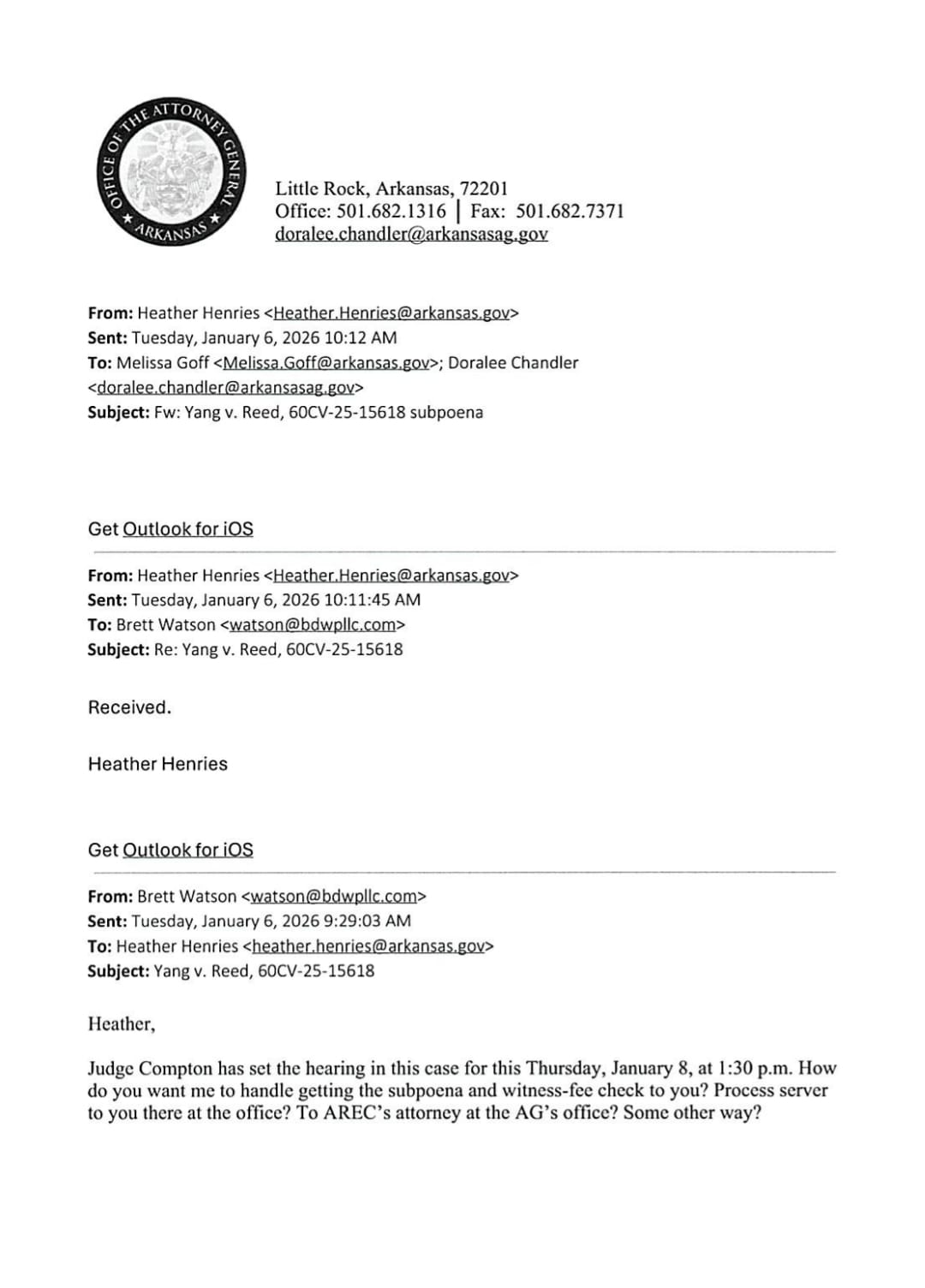
In another email Watson asked: "Did you formerly go by the name of Heather Garrett? I am trying to figure out who Casey Reed communicated with at AREC in some of his e-mails."
Henries wrote her name was once Heather Garrett.
In court on Jan. 8, Watson decided not to call her to testify although she was present in the courtroom. No reason was given.
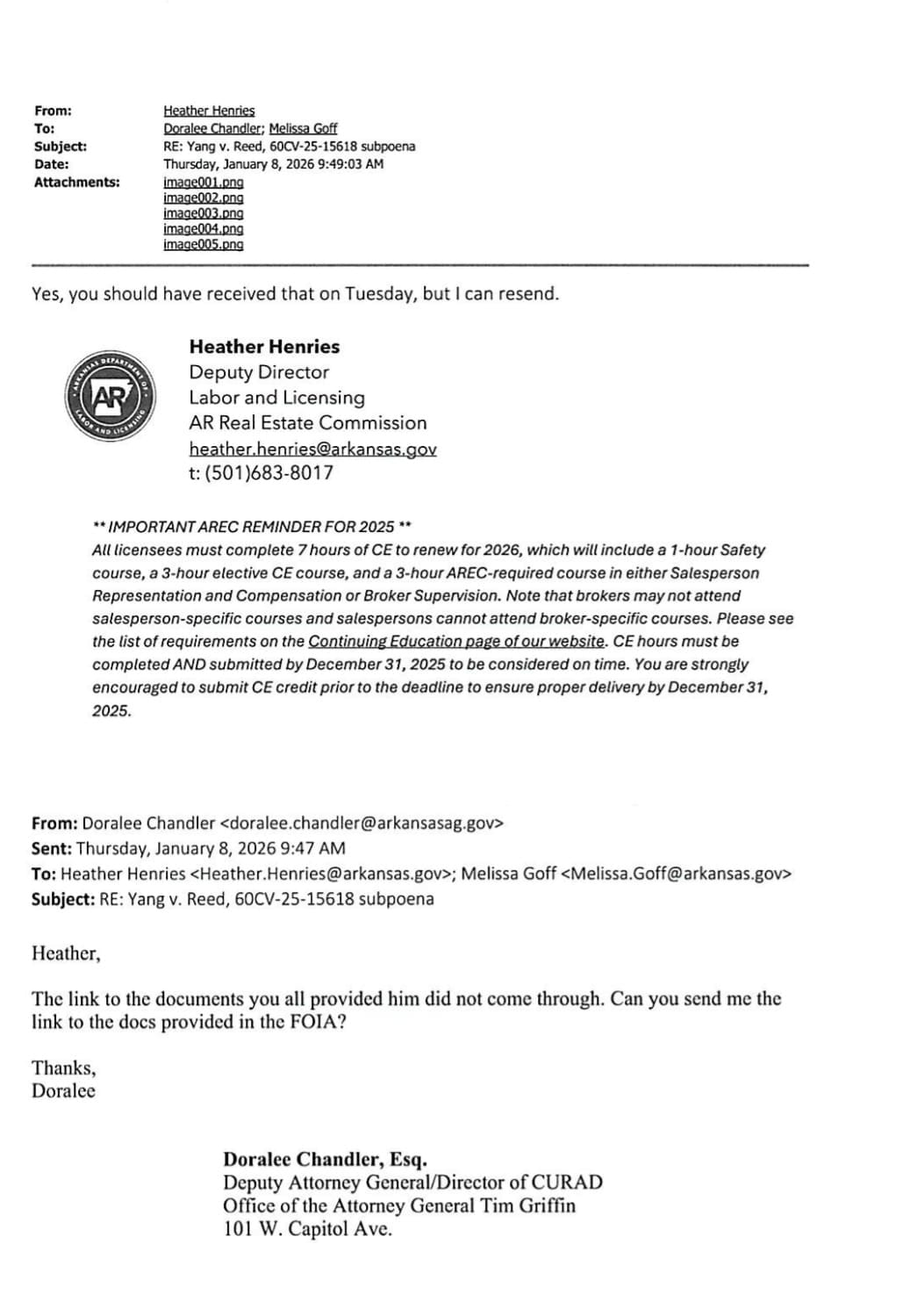
Watson and reporters weren't the only people seeking the Reed Real estate file. An attorney in Attorney General's Tim Griffin's office wanted it, too.
Reed's case was supposed to be sealed in Grant County, too.
The Reckoning sent a FOIA request to Grant County Prosecuting Attorney Teresa Howell on Dec. 29, 2024, asking for all documents related to the 2012 Reed case.
Howell wrote: "No records exist that are responsive to your request."
The Reckoning asked Howell this question: "Is this case sealed? Because according to a recent lawsuit, a case did exist in Grant County about Mr. Reed."
She replied: "No records exist that are responsive to your request."
Political intrigue
As Reed investigated himself, he sent a FOIA to Howell for documents concerning himself. He provided the Reckoning with those documents.
On Nov. 14, 2025, Republican state Rep. Matthew Shepherd, the attorney for the Republican Party of Arkansas, sent Howell an email asking about Reed.
Shepherd wrote: "As advised yesterday, I am the General Counsel for the Republican Party of Arkansas (RPA).
The RPA was provided information suggesting that Casey Reed a filed candidate for State Representative District 92 may have been charged and/or convicted of a felony for Abuse of Public Trust. The information submitted included the attached article referring to him pleading guilty to Abuse of Public Trust (see page 8)."
That attachment was a page from a March 2017 Real Estate Commission newsletter citing where Reed paid $500 for failing to tell the Commission about his 2012 plea.
Matthew Shepherd cited Arkansas Code Annotated 21-8-305 stating "If a person has pleaded guilty or nolo contendere to or has been found guilty of a public trust crime, he or she shall not:
(1) File as a candidate for:
(A) A constitutional office..."
He added, "This statute also provides that, '(b)(1) The sealing of any public trust crime or any similar offense under the Comprehensive Criminal Record Sealing Act of 2013, $ 16-90-1401 et seq., or any sealing or expungement act in any
jurisdiction shall not restore a privilege, eligibility, or qualification to file as a candidate for, run as a candidate for, or hold an elected office under this section. Ark. Code Ann. 21-8-305."
Matthew Shepherd wrote in his email to Howell: "This Subchapter was apparently passed into law in 2019, so timing of the various relevant events may also be of importance:
The RPA is referring this information over to you as Prosecuting Attorney pursuant to Arkansas Code Annotated 21-8-303, which provides, 'It shall be the duties and responsibilities of the prosecuting attorneys of this state to supervise compliance with this subchapter...' Ark. Code Ann. 21-8-303.
Matthew Shepherd continued, "I advised Mr. Janske that I would be making this referral pursuant to this section.
Please let me know if you have any questions, comments, or need additional information in determining whether Mr. Reed is eligible to run for and potentially hold office."
Shepherd also attached this document to his email to Howell. Reed told the Reckoning he gave the Republican Party of Arkansas the document to show his case had been dismissed. (The Reckoning blacked out Reed's Social Security number.)
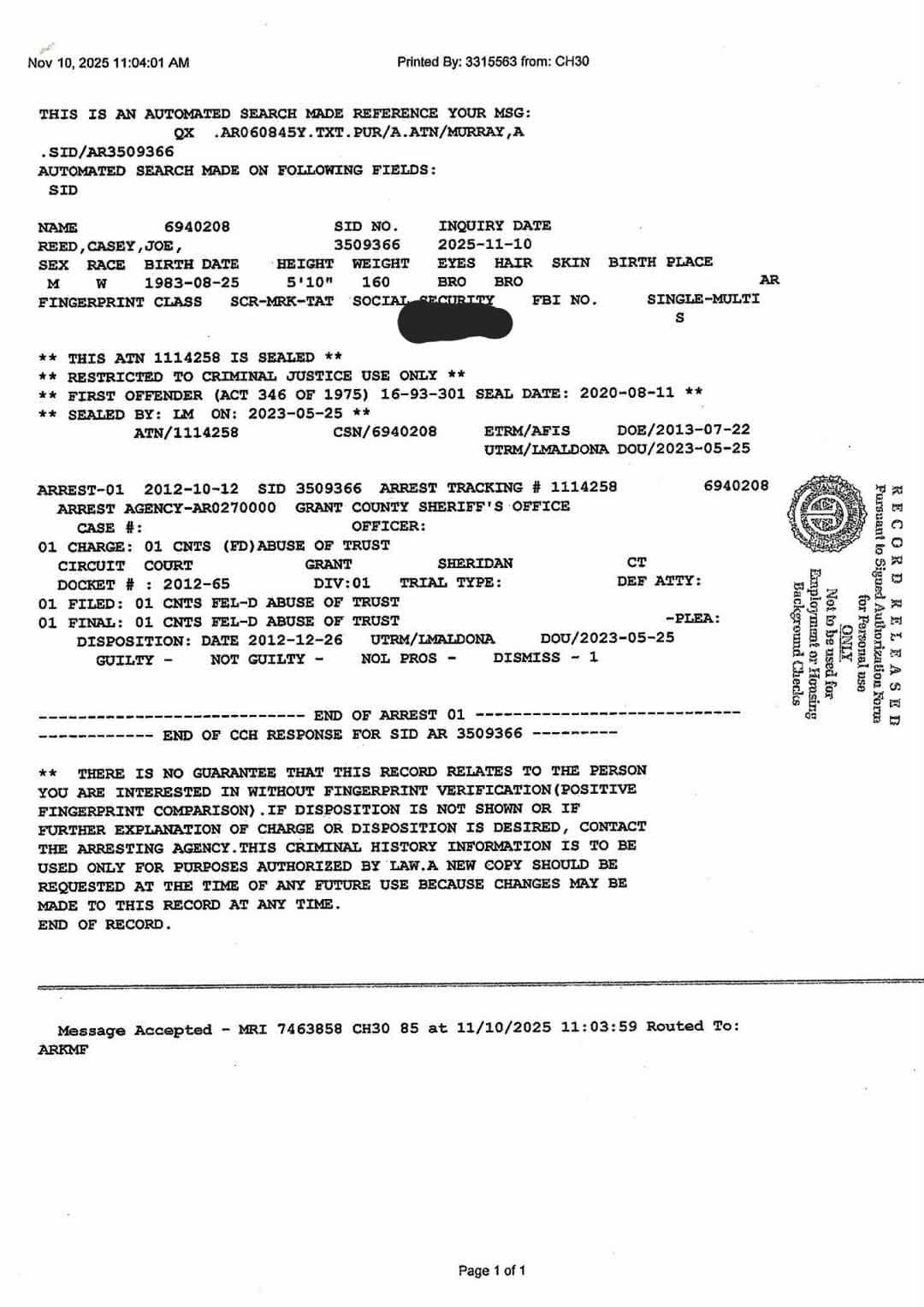
Howell responded to Shepherd. She wrote, "I received your November 14, 2025 email request for a compliance opinion under Arkansas Code Annotated Section
21-8-303. I am statutorily unable to respond to your request at this time."
On Dec. 4, 2025, another staffer – a criminal investigator – with Arkansas Attorney General Tim Griffin's office emailed Howell.
He wrote, "I am requesting a copy of the sealed records for the following individual:
• Casey Reed, WM, DOB 08-25-1983, arresting agency Grant County Sheriff's Office, date of
arrest 10-12-2012.
Please let me know when the file will be available for pickup. I will provide the required credentials and a signature for the documents."
It is unclear if Howell responded to that request. No emails show that she did so in writing.
On Dec. 12, 2025, another investigator with the Attorney General's office emailed Howell.
"We were taking another look at the issues in the Casey Reed election matter. I'm forwarding a couple of things that we found. One is an AG opinion that seems to relate to the facts here and the other is a statute regarding the effect of the 'title' of a statute. You may have already seen these and, if not, they may not be helpful to you but I wanted to pass them on. Please let us know if we can help in any way. Thank you."
It is unclear if Howell again communicated with the Attorney General's office.
Headed to Arkansas Supreme Court
Harrelson filed an appeal of Judge Compton's ruling to the Arkansas Supreme Court on behalf of Reed on Jan. 23.
All parties from Yang's original lawsuit are included in the appeal.
Yang through Watson filed a cross appeal.
Two justices – Associate Justice Nicholas Bronni and Associate Justice J. Cody Hiland – have recused from the case. Neither cited a reason for the recusals.
Bronni was appointed to the Supreme Court by Governor Sarah Huckabee Sanders on Dec 20, 2024. He is currently running for a full term on the Supreme Court.
Bronni's financial disclosure forms show that Watson, Yang's attorney, donated $500 to Bronni on Sept. 11, 2025.
Many of the same political action committees (PACs) that donated to Reed's opponent, Eric Shepherd, also gave to Bronni.
Hiland was elected the chairman of the Republican Party of Arkansas starting in December 2022. Sanders appointed him to the Supreme Court in July 2023.
She replaced Hiland with Joseph Wood as chair of the Republican Party of Arkansas on Aug. 19, 2023. Wood was named in Yang's lawsuit and Reed's appeal.
Like Bronni, Hiland is also running currently for a full-term on the Supreme Court.
Justice Barbara Webb has not recused although she received a $100 donation on Aug. 20, 2023, from Wood, the day after he was named Republican Party of Arkansas' chairman, according to filings at the Secretary of State's office. Wood also donated $75 to Yang in June 2023.
Webb's husband, Doyle, was chair of the Republican Party of Arkansas from 2008 to 2020.
In 2022, Yang was chair of the Saline County Republican Committee. That Committee met in a building in Benton owned by Doyle Webb until 2024 when the state party dissolved the Committee amid controversy.
The Reckoning also found a picture on another news outlet's site showed Yang and Doyle Webb along with two other Republicans together at an event.
A date has not been set for the Supreme Court hearing.
Reed has been in the political arena only for a short time, but he has seen a few things.
"Thus far, I’ve learned that politics leaves very little room for honest people," Reed told the Reckoning. "The system is deeply flawed, and people within it will go to great lengths to preserve their power, often at the expense of those who challenge it."