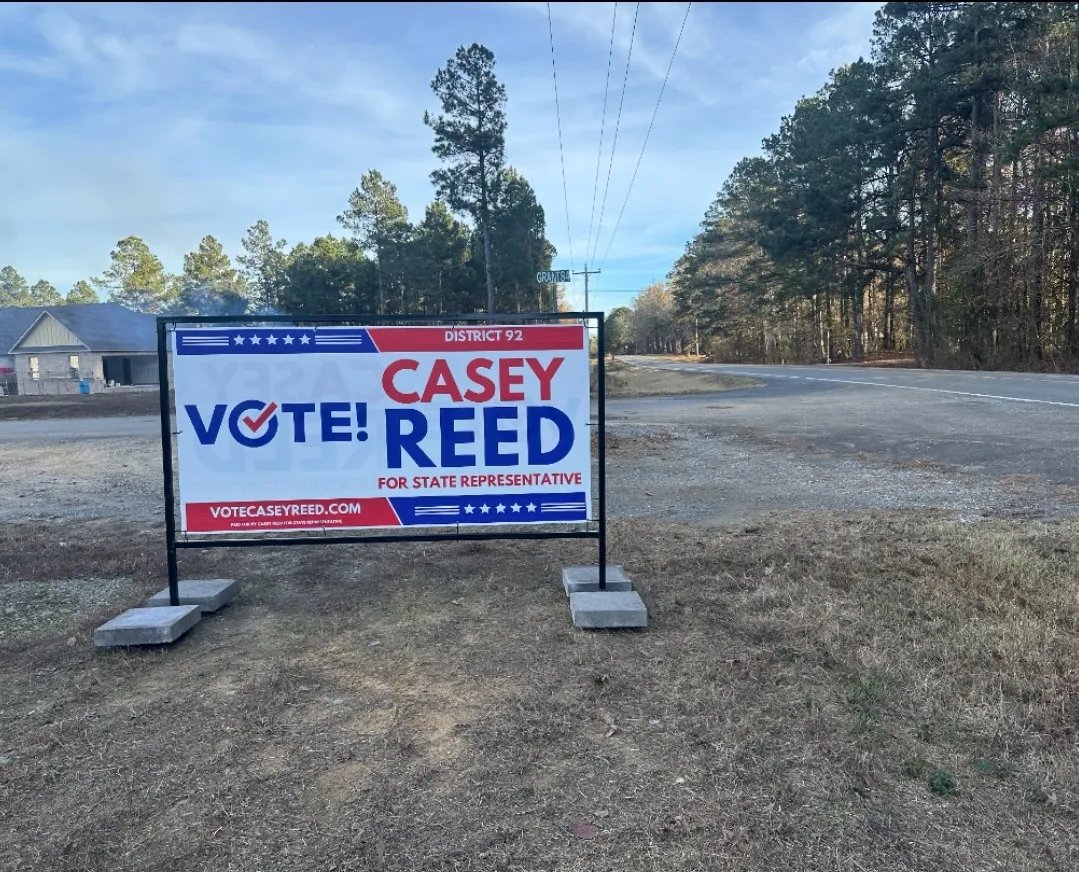
A proposed Grant County data center and a solar farm has placed hyperlocal races like Justice of the Peace and county judge on the radar of dark money Political Action Committees (PACs).
Much like the controversial prison project in Franklin County, the proposed data center near Sheridan has its own secret twists, complex turns and political games.
To add to the drama, outside political forces are trying to influence local races.
What is dark money?
According to Open Secrets' website, dark money "refers to spending meant to influence political outcomes where the source of the money is not disclosed."
That means when your neighbors, the candidates' supporters and influential local power players are no longer the only ones funding elections. It also means a mysterious outside interest group with a lot of money wants to control a town or county by helping candidates that could possibly be swayed to do whatever the dark money folks want done. More times than not the candidates don't even know a dark money entity is working on their behalf.
OpenSecrets, a national organization that monitors money in elections, states:
- Politically active nonprofits such as 501(c)(4)s are generally under no legal obligation to disclose their donors even if they spend to influence elections. When they choose not to reveal their sources of funding, they are considered dark money groups.
- Opaque nonprofits and shell companies may give unlimited amounts of money to super PACs. While super PACs are legally required to disclose their donors, some of these groups are effectively dark money outlets when the bulk of their funding cannot be traced back to the original donor.
Read more about dark money here from OpenSecrets.
Grant County darkness
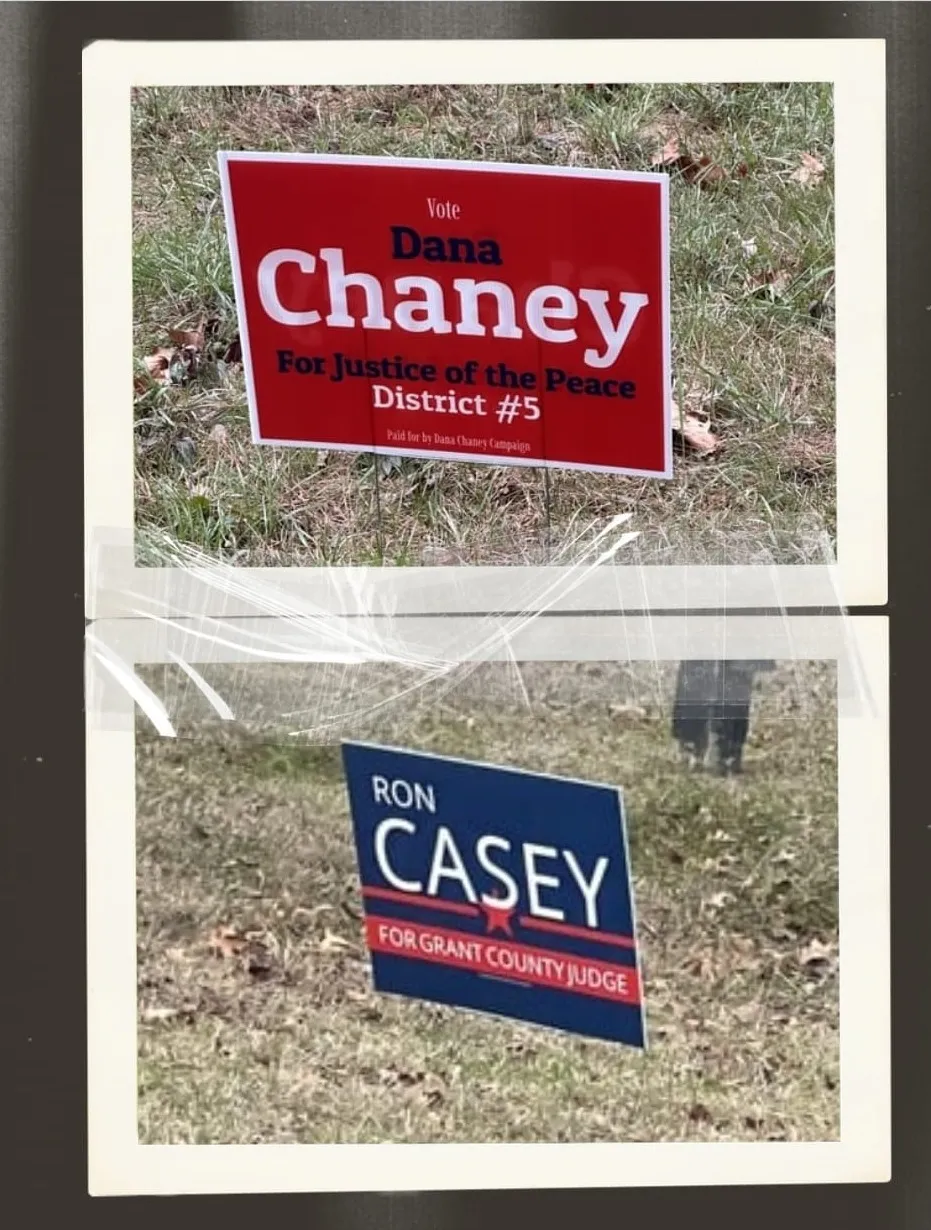
Grant County residents recently received two mailers from an organization supporting Ron Casey for county judge and Dana Chaney for Justice of the Peace.
Casey has two opponents – Jeff Vance, who works for the county, and Scott Wells, who owns a small cattle farm and is the current Justice of the Peace in the zone where the data center could be built. Wells is the only county judge candidate to publicly oppose the data center.
The dark money mailer supporting Casey states on one side that he is a Christian, a state trooper and a family man. (Casey recently retired as a state trooper after 39 years of service.) It also states Casey is "Standing For The Citizens of Grant County."
On the other side, the mailer states Casey will "Protect Private Property", "Increase Local Government Transparency" and "Bolster Rural Economic Development."
Under "Protect Private Property" it states: "Private property rights are fundamental to individual liberty
and prosperity."
Under "Increase Local Government Transparency", the mailer states: "Transparency in government is essential to ensure that citizens
have a voice in the decisions that affect their daily lives."
Lastly, under Bolster Rural Economic Development, it states: "Rural communities are an important contribution to our
nation's economy."
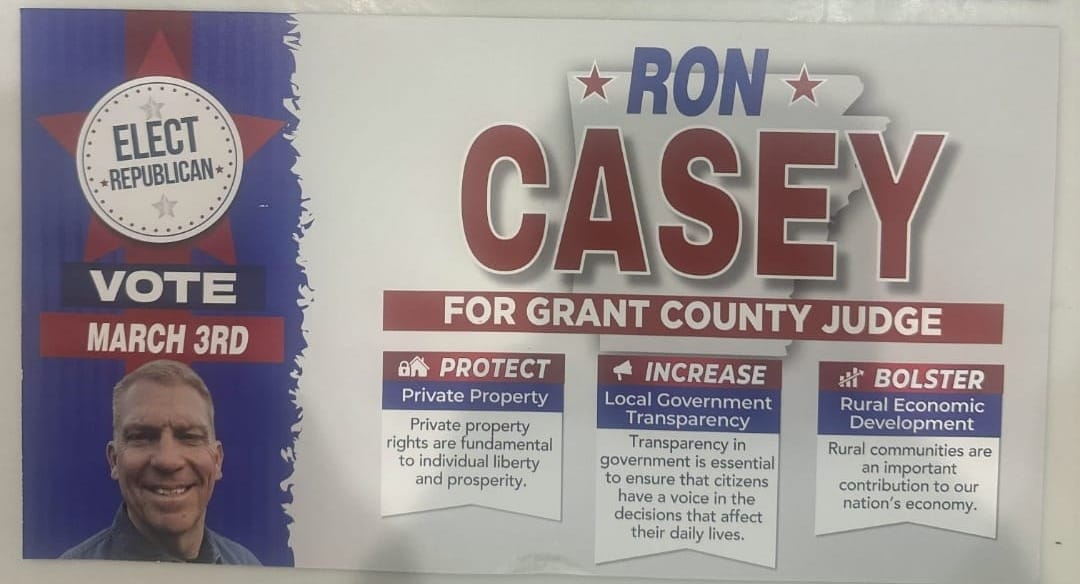
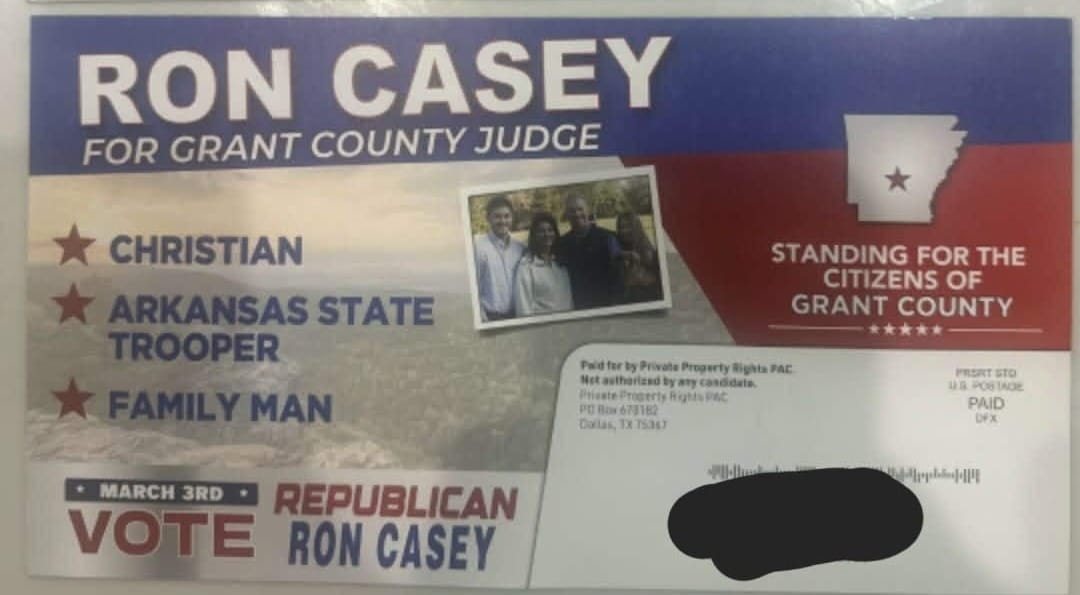
Grant County residents are receiving a similar mailer about Dana Chaney who is running for Justice of Peace against Brody Channell, a vocal opponent against the data center.
The mailer supporting Chaney states she is a 30-year healthcare worker and a Grant County native.
The Chaney mailer, too, has many of the same reasons to vote for her that the Casey mailer cites.
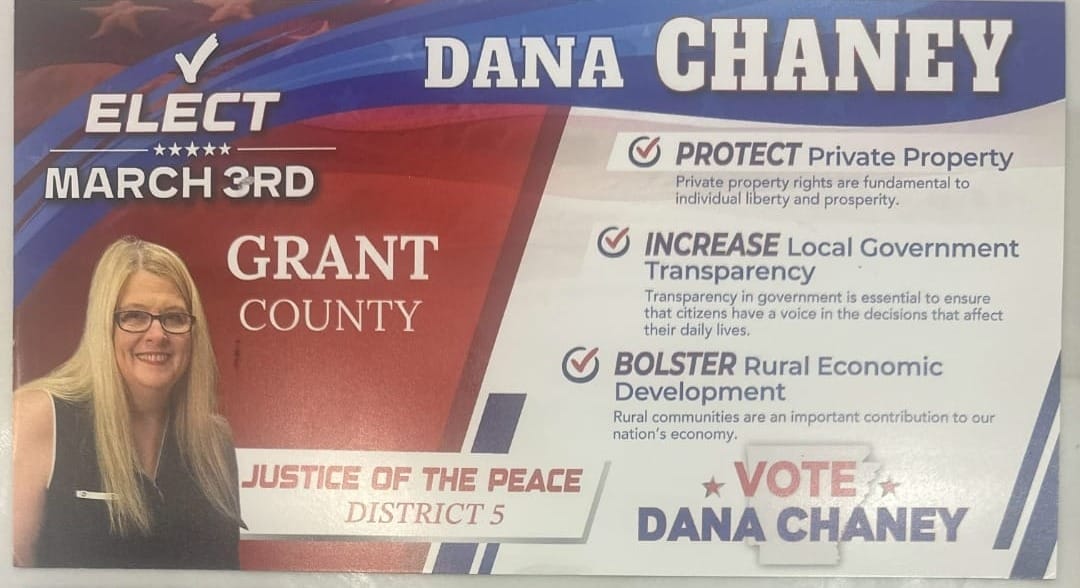
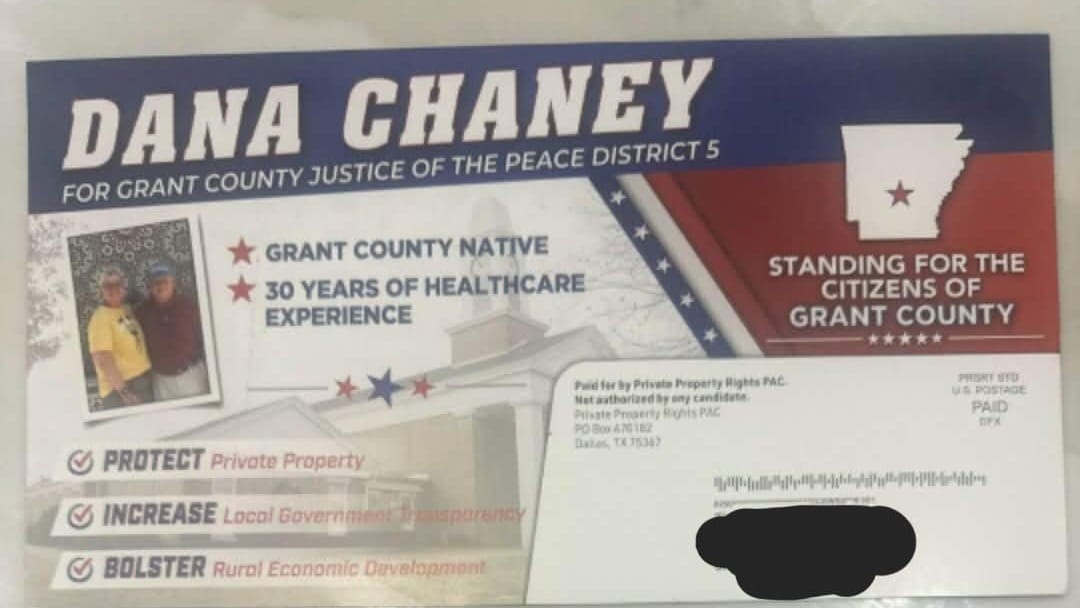
What is Private Property Rights PAC?
The return address on the Casey and Chaney mailers is Private Property Rights PAC with a PO Box in Dallas, Texas.
The PAC's website lists them in Holland, Michigan. The website states its "mission is to safeguard and promote the ownership and control of private property, ensuring it remains under the stewardship of rightful owners without undue governmental influence."
They support "candidates focused on private property rights often emphasize the role of these rights in fostering economic freedom and stability. They argue that secure property rights are essential for encouraging investment, entrepreneurship, and overall economic growth, making them crucial for a prosperous economy."
The last time a news release was posted on the site was May 27, 2025, when the PAC endorsed candidates in Virginia.
According to the Arkansas Secretary of State's website, the PAC has raised $161,330.30 and spent exactly that amount.
Tyler Lachowsky of Conway is listed as the PAC's registered agent. Campbell Hobbs of Austin, Texas, is also listed as an officer in the PAC.
The Secretary of State filing shows no donors to the PAC. Hence, the dark money aspect. Who is behind the $161,330.30? Because of campaign finance laws that information does not have to be disclosed.
The January 2026 filing with the Arkansas Secretary of State's office shows the PAC spending thousands of dollars to Right Strategies, LLC in Ankeny, Iowa, for printing and postage, SMS messaging and digital advertising to various candidates especially Justices of the Peace and County Judge races.
That report shows that on Jan. 27 2026, the PAC spent $1,950.00 for digital advertising for Casey, another $830.10 for SMS advertising for him, and $16,602.00 for printing and postage (the mailers).
On the same day, the PAC spent $1,669.50 on for printing and postage on Chaney's mailers, $750 for SMS messaging and $1,950.00 for digital advertising.
Ultimately, since this PAC does not have to disclose its donors, voters do not know who is really behind the advertising. According to Campaign Legal, "Super PACs are committees that can raise and spend unlimited amounts influencing elections, such as by running television or digital advertisements explicitly urging voters to support or oppose specific candidates, as long as they don’t coordinate their efforts with any candidate or political party."
The last financial filing from Casey to the Secretary of State's office was his year-end filing for 2025. In that filing, Casey had taken no PAC money, but then again, PACs such as the Private Property Rights PAC do not coordinate with the candidate.
Casey is not happy about the mailer.
"When I first heard about this mailer, prior to me getting several myself, I was furious," Casey told the Reckoning. "I knew I had nothing to do with it and was concerned that it would shed a negative light on my campaign. I didn’t ask for it and even though the flyer has some truths to it, some in my opinion are misleading. I am an unapologetic Christian that has strong beliefs in Christ. I am a strong family man. Even though I was a State Trooper, I am retired now.
"I do believe in economic growth, but I don’t want it to be construed to be supporting any controversial industries our county is or may be facing. I hate to not have control over what is being expressed about me. I don’t want to be associated with dark money. Even though I have been in law enforcement for almost 37 years, I’m not real sure what 'dark money' is and I don’t want any part of it. I have asked a lot of questions on where these flyers come from and how I got chosen. I have been told by several sources that it is against the law for these groups to contact me and vise versa. I want to run a clean and honest campaign and I don’t want things like these flyers to jeopardize my beliefs in how Grant County Elections should be. I respect both men running against me and I vowed to run a gentleman campaign. To sum up, even though I had no control over these flyers, I do not like they were sent out representing me."
Chaney did not have any filings with the Secretary of State's office on Monday. The Reckoning called the Secretary of State's Election Division Monday and was told she had not filed her signature card. Her Campaign Contribution and Expenditure Report had also not been uploaded.
However, on Wednesday, the Secretary of State's website posted Chaney's documents with a filing date of Feb. 24. No PACs have donated to Chaney and only one individual donated $350 to her.
The Reckoning emailed Chaney about the mailers from the Private Property Rights PAC but she did not respond.
What's going on?
Private property rights is at the heart of the battle for land owners who want to put solar fields and data centers on their property with limited government intervention.
The Private Property Rights PAC and the Private Property Rights Institure align with an organization called Evergreen Action.
According to a report, "Evergreen Action is a national policy and advocacy organization focused on advancing an equitable and thriving clean energy future. The Private Property Rights Institute (PPRI), rooted in conservative principles, is committed to defending private property rights and limiting unnecessary government overreach."
That same report states, "Across the country, farmers are navigating shifting economic pressures—from
declining crop commodity prices and rising operating costs to labor shortages and increasingly unpredictable weather conditions that are making growing more
challenging. In response, many are exploring new, voluntary revenue streams that help keep land in the family and operations profitable.
Leasing land for wind, solar, battery storage, and other energy projects has become a reliable, drought-proof source of income for rural landowners—helping sustain farms,
boost local economies, and support long-term community investment."
Local Grant County residents have found through courthouse documents that approximately 37,000 acres in the county have either a lease contract or a memorandum contract with solar farm entities.
Solar, data centers and now dark money – the current political waters in Grant County have become muddier.